

Employer branding: an HR trend or a business strategy?
Over the past few years, employer branding has become a topic our market is paying increasing attention to. Many companies have recognized the importance that a strong employer brand and a well-defined employer branding strategy have for both attracting and retaining people. But is this just a passing trend, or is it a business strategy?
The answer lies in the labor market, which has changed significantly. Before submitting an application, candidates usually research employers online. They look at the company culture, read employee reviews, explore career-focused pages on social media, and visit the employer’s website. Based on all of this, they assess the employer’s reputation and decide whether to apply.
Candidate recruitment directly affects not only costs, but also team stability. Very often, the internal role of employer branding, among existing employees, is even more important. The perception of the employer brand influences employee retention, satisfaction, loyalty, motivation, advocacy, and more.
The answer, therefore, seems clear: employer branding is not, and must not be treated as, a matter of trend. It is a long-term strategy, directly connected to both the brand and business strategies. A strong employer brand not only reduces costs and saves time, but it has also become an integral part of business competitiveness.
“According to LinkedIn research, companies with a strong employer brand reduce hiring costs by 43% and attract 50% more qualified candidates.”
Employer branding is not a campaign
An employer brand exists even when no deliberate effort is made to manage it. It is a misconception that employer brands are built only by large companies with dedicated departments, agencies, and campaigns. An employer’s image is being shaped continuously. Every candidate who comes in for a job interview, every employee, and even every associate forms an impression of what the company is like as an employer, and shares that impression in different situations.
“An employer’s reputation is built even without the employer’s involvement, but the responsibility and consequences always belong to the employer.”
When we talk about a brand, on the one hand, there is what the brand promises, which shapes expectations. Every contact with the brand creates an experience of it. Our expectations are then met, or not met, to a greater or lesser extent. The intersection between what we expected and what we experienced shapes the brand’s perception. That perception can be positive if expectations are met, or negative if they are not.
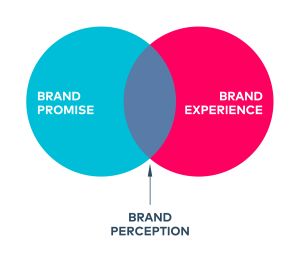
The employer brand operates on the same principle.
Take an employer that looks desirable from the outside. It appears on lists of top employers, showcases career success stories, excellent working and development conditions, and the company’s stability and strength. You have seen this employer’s campaign and applied for a job because you want to be part of that team.
Based on everything you have seen, you form certain expectations. This is where your experience with the employer actually begins. The entire recruitment and selection process, communication with the HR team, onboarding, team support, internal culture, and every day at work all make up the candidate and employee experience. These experiences are precisely what shape the employer brand’s perception.
The external communication on LinkedIn and the job ads that attracted you have not changed. What certainly does change is your perception. And that perception is no longer based only on expectations, but on the experience you have actually had. The image of the employer in your mind is now different. Better, equal to your expectations, or worse, depending on how closely what you imagined before joining the company matches what you experienced once you joined.
You live through these experiences every day, in a variety of work situations. That is why employer branding is a topic employers must address every day and at a systemic level, rather than through sporadic campaigns or one-off activities.
Myths and truths about employer branding
The most common myths are also the most expensive ones for a company.
MYTH 1: Employer branding is only relevant for large companies
The truth lies somewhere in between. For small and micro businesses, how they position themselves as employers is equally important. Serbia is a small country, and if we narrow it down to a single city, an employer’s image spreads quickly.
What is different is the extent to which a company needs to actively manage its employer brand. In large companies, the level of control over the employee experience is not always high, and the experience often varies across departments. It may also depend on the leadership style of individual managers or on the roles people hold within the company. Some positions may come with benefits such as flexible working hours or remote work, while for others, this may be operationally impossible. This is why larger companies need more engagement and a more systematic approach to employer branding.
Smaller companies do not face these challenges in the same way. It is often the case that owners know all employees personally, have a strong influence on the internal culture, and can communicate and transfer it more effectively across the entire team. This does not mean that employer branding should be neglected in smaller businesses, but dedicated departments, teams, and campaigns are practically unnecessary. It is enough to define the values and internal culture, and then monitor how they are applied and nurtured, consciously and strategically.
MYTH 2: Employer branding is the responsibility of the HR department
Statements like this reveal a completely mistaken perception of employer branding. The HR department can, and should, initiate the process, but the way an employer brand is perceived by candidates is shaped by all employees. This includes everyone from a manager who may communicate in ways that contradict the internal culture to an employee posting a story from a team-building event.
So the next time you ask yourself: How is it possible that we cannot find suitable candidates? What is that HR department doing? Consider whether you, too, have contributed to the perception of your company’s employer brand, and in what way.
MYTH 3: It is enough to have a well-managed LinkedIn/Instagram page and job ads
Looking good on the outside while lacking substance on the inside is neither enough nor desirable in any area of life or work. Aesthetics without substance, or a polished image with no basis in reality, ultimately does more harm than good.
A well-managed social media page is not a sufficient indicator. First of all, if an employer wants to make serious progress, employer branding must be connected to the wider communication system, across all touchpoints with both candidates and employees.
What is especially important is that the content shared, whether internally or externally, must be relevant. We cannot rely solely on social media trends and attractive visuals. The content plan must be set strategically, based on the employer’s goals and employee value proposition, the reason why someone would want to work for that particular employer, and what makes it unique.
How does a strong employer brand affect business performance?
Let’s also look at the numbers and see how employer branding affects business performance:
Lower hiring costs and a faster selection process
Desirable employers receive more relevant applications because people simply want to work for them. This reduces recruitment costs, shortens selection time, and makes the entire process faster, which means less pressure on teams.
Employee retention and team stability
“According to Glassdoor research, companies that actively invest in their employer brand see 28% lower employee turnover.”
Employer branding is especially important in internal communication because it directly affects employee retention and team stability. If employees feel valued, informed, involved, supported, and given room to grow, they are more likely to stay with the team longer. Team stability is particularly important. Every fluctuation, whether small or large, disrupts the team, and no matter how well-structured the system is, it costs time, money, and focus.
Motivation and productivity among those who stay
When people understand the company’s values and feel a sense of belonging, motivation is significantly higher. Company culture and the employer brand are closely connected. Culture is the foundation, while employer branding is how culture is seen, experienced, and communicated.
Impact on sales
Customers and partners are increasingly paying attention to how employers treat their employees. A negative employer image has become part of a company’s overall reputation and has a growing impact on sales and brand perception. There are numerous examples of consumers boycotting brands because of how they treat employees and use cheap labor.
What makes a good employer branding strategy?
This may be a good moment to point out that, before developing an employer branding strategy, any fundamental issues should be addressed, if they exist. A good strategy will not cover up what is not working, but it will help highlight what is working well. If an employer is not ready to improve the work environment and has no real ambition to become a genuinely good employer, all employer branding activities become harder to implement and can quickly turn into slippery ground.
Sometimes, shortcomings are identified during the strategy development process itself, which is also a positive outcome.
The steps we recommend when developing an employer branding strategy are the following:
Defining the starting point and the desired destination
The zero step is an audit: an analysis of where we stand as an employer today, our positioning, and the external and internal perceptions.
From there, when working on strategies, we take business goals as the starting point. The entire system that makes up a business should be rowing in the same direction, towards business progress. That is why an employer branding strategy should also begin with the business strategy.
For example, if the plan is business growth, opening new locations, and expanding teams, then the employer branding strategy should support those goals by focusing on external activities that attract the right talent, as well as on onboarding activities that ensure positive first experiences for new employees.
If the plan is not to hire new people but to retain and develop existing teams, then the goals should focus on internal activities and communicating benefits and development opportunities.
Employee value proposition
The EVP should answer the question: What does the company genuinely offer its employees? And here, we are not only talking about salary and benefits but also about the company’s stability, opportunities for growth and development, leadership style, and values.
The EVP should define the key pillars around which communication and the content strategy will later be built. Through these pillars and key messages, it is important to give candidates clear reasons to choose that particular employer.
Tone and style of communication
In practice, companies most often “fall” on what seem to be the easiest questions. Tone and style of communication are always slippery ground. The reason is consistency.
The principle itself is quite simple: define the way the employer communicates, in line with the company and/or the brand. Define the topics that come from the EVP, the key messages, and the phrases to use when creating content.
In reality, the problem arises when content creators, whether they work on external or internal communication, do not follow these guidelines. They drift into trends, personal preferences take over, and as a result, the messages being sent are no longer aligned or unified, and they lose their strength.
Choosing the right communication channels
This is another area where confusion often appears: what is currently trending, which communication channel serves which purpose, and so on. What simplifies the process is a clear overview of all the touchpoints a person goes through, from being a candidate to becoming an employee, to leaving the company.
This means that, first, we have external channels such as the careers page on the website, social media pages, profiles on job platforms, and similar channels. Then comes the entire recruitment and selection process, which includes email communication, interviews, offers, and more. After that come employment and onboarding, followed by all employee experiences during their time at the company: from the physical workspace to internal communication channels such as the intranet, email, notice boards, and finally, the exit from the company, which is equally important.
All of the above are touchpoints and, therefore, communication channels as well.
Planning employer branding activities
A strategy without an action plan remains just words on paper. To deliver results and truly come to life, it is necessary to create a plan and define the division of activities: who does what next and when.
Ideally, this should be done annually, with more detailed planning at the quarterly and monthly levels. This approach gives us better control over employer branding activities and better monitoring and planning.
Also, if the process of defining communication channels shows that certain channels or processes require additional attention, it is necessary to set priorities in a way that allows all channels and touchpoints to be systematically aligned over time and placed in the service of one unified, broader employer image.
When is the right time to start working on employer branding?
The first right time has already passed. If you are not actively working on your employer brand, you are already behind.
The second right time is today. What you can do immediately is conduct an audit, analyze where you currently stand, and identify your weak points.
Employer branding is definitely not a trend, and it is here to stay. It is also not cosmetic work that can cover up poor working conditions or poor treatment of employees. The impact of the employer brand on business is too significant to ignore.
Whether you allow your employer brand to put your business at risk or use it as a strong wind in your company’s sails is up to you to decide.
The moment you make the right decision, regardless of how late you may be, we are here to provide full support. Our experience shows that it is never too late. The only question is the scope of work ahead of you. The longer you postpone it, the bigger the problem becomes, and the harder it is to solve.
If this text has inspired and motivated you to approach employer branding systematically, get in touch with us so we can assess together which approach would be best for this important investment.
Frequently asked questions about employer branding
To conclude, here is a brief summary that answers the key questions about employer branding.
What is employer branding?
Employer branding is the way a company builds its reputation as a place to work. It includes everything that candidates, employees, and the wider public think and feel about the company as an employer.
An employer brand is not made up only of job ads and LinkedIn posts. It also includes employee experiences, internal culture, communication, leadership style, the selection process, onboarding, day-to-day work, and even the experience of leaving the company.
Why is the employer brand important?
A strong employer brand helps companies attract better-quality candidates, reduce hiring costs, and retain employees for longer.
Today, before submitting an application, candidates research employers online. They examine the company culture, read employee feedback, and assess the values and atmosphere within the team. This is why employer branding directly affects a company’s competitiveness in the labor market and its overall reputation.
Who is responsible for employer branding?
Employer branding is not the sole responsibility of the HR department. Although HR often initiates and coordinates activities, the employer brand is built by all employees and all leaders within the company.
The perception of an employer is shaped by how managers communicate, internal culture, employee experiences, and how the company responds in everyday situations. That is why employer branding requires cooperation between HR, marketing, management, and the entire team.
How is employer branding measured?
The success of an employer branding strategy can be tracked through different indicators, such as:
- the number and quality of job applications,
- time to hire,
- employee turnover,
- employee satisfaction,
- employee referrals,
- engagement on career channels and social media,
- The company’s reputation on employer review platforms.
It is important that employer branding goals align with the company’s specific business goals.
Should small companies work on employer branding?
Yes. The employer brand matters for small companies too, especially in smaller markets where reputation spreads quickly.
Small businesses often have an advantage because they can build culture more directly, create closer team relationships, and communicate more authentically. Although they may not have dedicated employer branding teams or large budgets, clearly defined values, a strong internal culture, and consistent communication can make a significant difference.
Author: Milka Negrović, Executive Director at Homepage agency and a brand & marketing consultant with more than 10 years of experience in employer branding and branding.
