

What is an Employee Value Proposition (EVP) and how to build one in 2026?
An employee value proposition (EVP) is the overall value an organization offers employees in exchange for their skills, experience, and commitment.
According to Gartner research, companies that consistently deliver on the promises communicated through their EVP can reduce annual employee turnover by up to 69%.
Contents
- What is an employee value proposition?
- EVP vs. employer brand – what’s the difference?
- Why is EVP important for business success?
- The 5 key components of an EVP
- How to build a strong EVP
- Frequently Asked Questions (FAQ)
What is EVP, really?
An employee value proposition (EVP) is the combination of benefits, opportunities, and values a company offers employees in exchange for their contribution, effort, and loyalty. It’s not just about salary. EVP encompasses everything that makes people want to work for your company rather than a competitor.
An EVP includes:
- Compensation and benefits (salary, bonuses, rewards)
- Work-life balance (flexible working hours, remote work options)
- Career stability and growth (training, promotions, mentorship)
- Work environment and company culture
- The organization’s values, mission, and social purpose
In short, an EVP is the promise you make to your employees and the foundation of your employer brand.
EVP vs. Employer Brand: What’s the Difference?
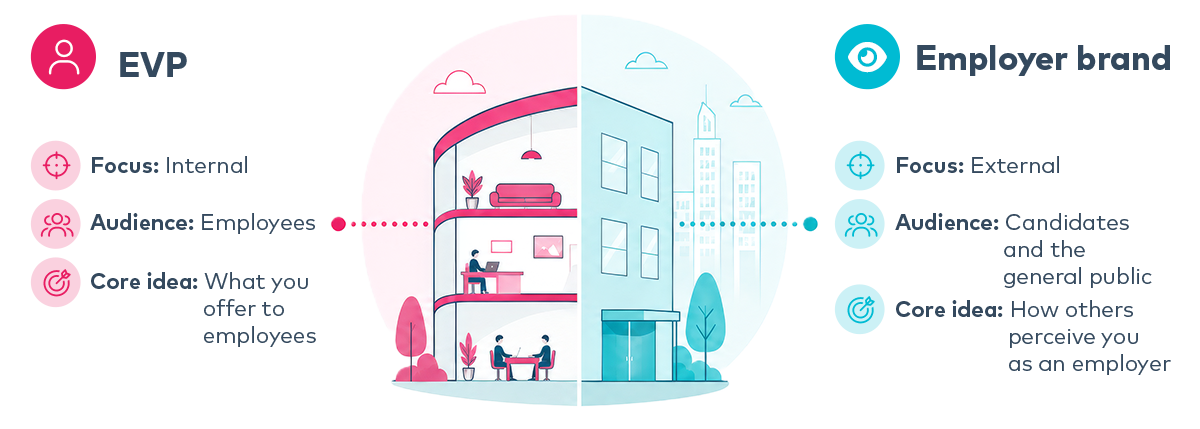
There is often confusion between these two terms, but the difference is quite clear. EVP focuses on internal practices and the actual experience employees have within a company, while employer branding is more about external perception — how others see you as an employer.
What’s important to understand is that one cannot function effectively without the other. EVP is the core foundation from which a strong employer brand is built.
Why is EVP important for business success?
A well-defined employee value proposition delivers measurable business results:
- Reduces employee turnover — when employers clearly define the value they provide, and the employee experience aligns with the promises they make, employees are more satisfied and stay longer. According to Gartner, turnover can be reduced by up to 69% annually.
- Increases employee engagement from day one — a clear vision and strong company values positively influence employee engagement from the very beginning. The same Gartner research found engagement levels to be up to 30% higher.
- Boosts profitability — highly engaged teams directly contribute to revenue growth. According to Gallup, companies with highly engaged employees see 23% higher profitability.
- Lowers recruitment costs — when companies clearly communicate the values they offer, they attract candidates who genuinely align with those values. As a result, both the time and money invested in recruitment decrease.
- Builds trust and transparency — numerous studies show how important open communication and clear expectations are to employees. Employers who are transparent about what they offer and consistently deliver on those promises build stronger relationships with their teams. As in any relationship, honesty matters.
The 5 Key Components of an EVP
An effective employee value proposition is built on five core pillars:
1. Compensation
This includes salary, bonuses, rewards, and performance evaluation systems. There is often a misunderstanding when interpreting research that suggests salary is not the top factor in employee satisfaction. While salary may not rank first — or even among the top three factors — this does not mean employees will choose an employer with inadequate pay simply because other benefits are attractive. Salary is, in many ways, the foundation. If it does not cover basic living needs, no additional perk can truly compensate for that.
According to the JLL Workforce Preference Barometer (2025), which surveyed 8,700 employees across 31 countries, more than half of employees cite salary as a reason for changing employers. However, compensation is no longer the only — or even the primary — driver of satisfaction. Employees increasingly look for a complete value package.
And compensation is not just about money. Non-financial forms of recognition that align with both employee and employer values also play an important role.
2. Work-Life Balance
Flexible working hours, remote work options, paid time off, and parental leave are all benefits that significantly impact employee satisfaction. We often say that people are our priority, that they care, and that employees matter. But proving that in practice is not always easy. For example, a company may describe itself as family-friendly and supportive of parents. That sounds great — but can parents actually stay home with a sick child without financial consequences? Can they attend their child’s school or kindergarten events during working hours? Those everyday moments are what truly define whether a company supports work-life balance.
3. Stability
Stability means both psychological safety in the workplace and long-term career stability through opportunities for growth, advancement, and professional development within the organization. Younger generations, in particular, are increasingly choosing companies where they can grow — not just perform tasks. Personal growth and development matter, even when employees may not openly express it.
Psychological safety also makes a major difference, especially during periods of global uncertainty and crisis. Interpersonal relationships play a significant role here. Simon Sinek once spoke about the “Golden Circle” — a work environment where people feel secure and accepted, allowing them to focus their energy on meaningful work instead of worrying about office politics or unhealthy competition.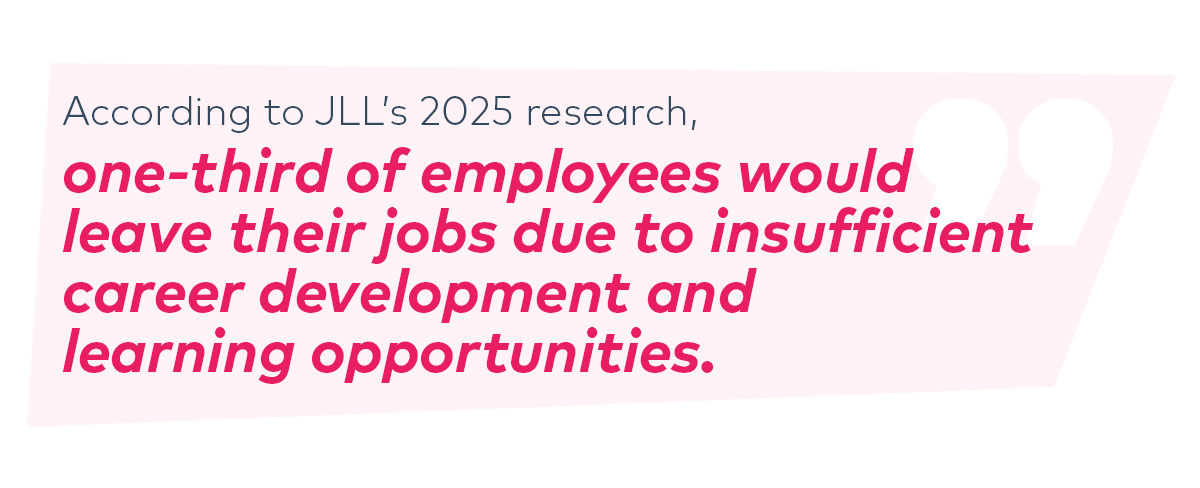
4. Location and Work Environment
In the era of hybrid work, location is no longer just an office address. It also includes organizational culture, employee autonomy, and the quality of both the physical and digital work environment. When teams are not physically together, the workplace becomes digital — and that creates new challenges. It becomes increasingly difficult to keep remote employees informed, connected, and engaged. And when people spend most of their working hours alone at home, it can become less important who they work for.
5. Respect
Relationships with colleagues, leadership style, inclusive culture, and company values all strengthen — or weaken — the employee experience. McKinsey research shows that uninspiring and disengaged management is among the top three reasons employees leave their jobs.
Not to place all the responsibility on management — I personally believe that each of us contributes to and influences the work environment. Each of us is someone’s coworker, and our attitude and approach matter and contribute to the overall atmosphere. When someone asks my colleagues what their coworkers are like, their answers will also reflect me.
How to Build a Strong EVP
Step 1: Identify what makes your company different
What do you offer employees that competitors do not? What values and opportunities are unique to your company? The answer to that question is the foundation of your EVP. It is important not to get carried away by trends and what is currently considered popular. It is completely okay not to offer something that has become common practice. For example, even though employees highly value remote work, you do not have to adapt to that. If you believe it is important for your business that people come to the office, that is perfectly fine. Not offering remote work will probably discourage some candidates from applying, and that is fine too. The people who apply will be those who do not see remote work as a priority and who are comfortable with (or even prefer) working from the office. It is actually quite simple — communicate openly about who you are and what you offer. There will always be candidates who are looking for exactly that and who share your values.
Step 2: Listen to employee needs
Run surveys, focus groups, and one-on-one conversations. Employee needs vary depending on generation, life circumstances, and career ambitions. The only way to build an EVP that truly works is by listening.
IMPORTANT: if you ask, be ready to listen. Do not put yourself in a position where you constantly run surveys and ask questions but never act on the feedback. If employees do not see that changes are happening and that someone is actually listening, those surveys will eventually lose all meaning. People often say, “Why do they keep asking when nothing ever changes?”
Step 3: Align your EVP with your company’s mission and values
Your EVP has to reflect what your company truly is and what it stands for. If you promote flexibility but it does not actually exist, you lose trust. And trust is one of the most valuable things a company can have. It takes a long time to build and very little time to lose. Honesty is extremely important here — especially honesty with yourself.
Let’s say you are a more traditional engineering company. You value expertise, dedication, and loyalty. At the same time, trends indicate that employees increasingly want flexibility, remote work, and greater decision-making autonomy. Your approach to growth, your mission, and the values you have built over the years may not align with that. Do not force yourself to become something you fundamentally are not. Be honest and confident about who you are, what your values are, what you offer, and what you expect in return. The people who are comfortable with that will be interested in working for you. Those who are not simply will not apply, which saves time for both sides.
One engineer may come to work in sweatpants and a Star Wars T-shirt, while another with the same title may prefer trousers and a shirt under a sweater. There is a work environment that suits both.
Step 4: Be authentic
Employees quickly notice the gap between what a company promises and what it actually offers. An authentic EVP builds trust, while an insincere one destroys it.
Authenticity does not end with identifying and defining a set of values. That is actually where it begins. Through work with experts, EVP is defined as the essence of what the company already is. After that, it becomes the foundation for all future activities and communication.
If you already have strong mentoring programs, development opportunities, room for advancement within the system, and a clearly defined career path, then growth will naturally become one of the values within your EVP. That becomes both a conclusion and a starting point — how, where, and when you communicate growth as part of your EVP, what you do to further improve those processes, and what new opportunities and activities you create.
Step 5: Make your EVP tangible
Connect your EVP to specific policies: flexible working hours, mentoring programs, and annual bonuses. Employee stories are the strongest proof, and for those stories to exist, the EVP has to be lived and applied — not just written down as a value on paper.
Do not allow a situation where you offer a benefit, but people cannot actually use it due to workload and pressure.
If you talk about work-life balance, but emails and requests keep coming in over the weekend, or the workload is so heavy that people constantly work overtime, then even the best-defined EVP will not help — quite the opposite.
I remember one example where an employee said, “You’re paying for an app that teaches me how to breathe, while I can’t breathe because of work.”
The app was part of a well-being program focused on work-life balance.
Step 6: Address every stage of the employee lifecycle
Your EVP should be present (and relevant) at every point of contact between the employer and employees. From attraction and recruitment, through onboarding and development, all the way to offboarding and leaving the company.
The best approach is to create a map of all the touchpoints where candidates and employees interact with the employer. That map is quite complex, with many opportunities for EVP communication. From job ads, applications, and email communication, to interviews and eventually leaving the team. Even a poster in the kitchen can become a touchpoint for communicating an internal program or benefit.
Step 7: Integrate EVP, employer branding, and employee experience
These three elements together create a cohesive experience that increases engagement, reduces turnover, and attracts the right people. They need to be aligned and continuously developed. The most common mistake I see is responsibilities being divided across different teams. Employee experience ends up under HR, while employer branding belongs to the communications team. Everyone does their best in their own area, but in the end, it looks like an orchestra of experienced musicians playing different songs. You can imagine the result.
The best situation is when one team connects all three areas — defined EVP, employee experience, and employer branding — into a single whole, through both activities and communication, internal and external.
Step 8: Communicate your EVP effectively
Use job descriptions, your company website, LinkedIn, employee reviews, and internal communication channels. An EVP that exists only on paper is worthless. Go back to the touchpoint map mentioned earlier. All of those touchpoints are opportunities and should be used intentionally, with clearly defined topics and activities.
Step 9: Measure Results
Track employee retention, engagement, recruitment costs, and employee satisfaction. Use that data to continuously improve your EVP. Ask people questions and, more importantly, listen to them. What do they value? What bothers them? What would they keep, and what would they leave behind?
There are situations where you already know something bothers employees, but you also know the system is set up in a way that cannot be changed. In that case, do not ask questions about it. It is better to focus on what can actually be improved.
Frequently Asked Questions (FAQ)
What is an employee value proposition (EVP)? An EVP is the set of values, benefits, and opportunities a company offers employees in exchange for their contribution and loyalty. It includes compensation, work-life balance, stability, work environment, and a culture of respect.
What are the key components of an EVP? The five key components are: compensation, work-life balance, stability, location/work environment, and respect.
How does EVP impact employee retention? Companies that effectively deliver on their EVP can reduce annual employee turnover by up to 69%, according to Gartner research.
What is the difference between EVP and employer branding? EVP is the internal promise made to employees — what they receive in return for working at your company. Employer branding is the external representation of that value — how the public and potential candidates perceive you as an employer. EVP is the foundation of employer branding.
How do you build an authentic EVP? Include employees in the development process, conduct surveys and conversations, align the EVP with the company’s real values and culture, and connect it to concrete policies and practices. Only once you are sure the EVP is clearly defined and truly lived should you build an employee communication strategy around it.
How often should an EVP be reviewed? An EVP should be continuously monitored using key metrics such as satisfaction, engagement, and turnover, and revised whenever employee needs, market conditions, or company strategy change significantly.
Employee value proposition is not a one-time project. It is built every day through culture, people, and the decisions you make as an employer.
